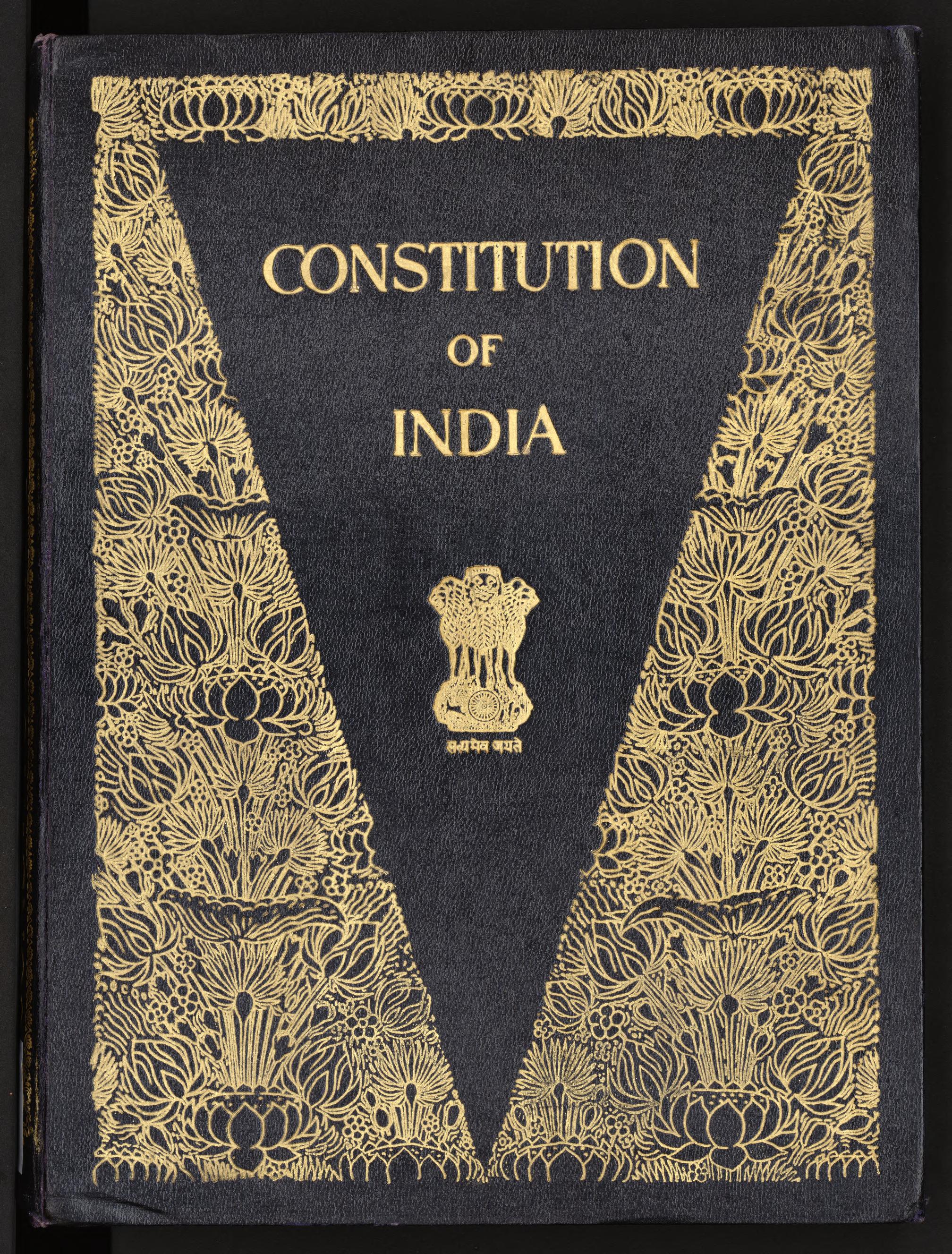
Indian Constitution
The Constitution of India is not just a legal document—it is the foundation of our democracy and national unity. The Constitution of India is the supreme law, establishing India as a Sovereign Socialist Secular Democratic Republic with a parliamentary system, guaranteeing fundamental rights and duties, and outlining government structure.
It's the world's longest written constitution, detailing fundamental political codes, procedures, and powers, binding all government branches and citizens.
The Government of India Act 1935, mainly drafted by Samuel Hoare, provided the basis for the constitution of India. The Constituent Assembly of India adopted the constitution on 26 November 1949 and became effective on 26 January 1950. It became the country's fundamental governing document, and the Dominion of India became the Republic of India. To ensure constitutional autochthony, its framers repealed prior acts of the British parliament, in Article 395. India celebrates its constitution on 26 January as Republic Day.
History
In 1928, the All Parties Conference convened a committee in Lucknow to prepare the Constitution of India, which was known as the Nehru Report.
With the exception of scattered French and Portuguese exclaves, India was under the British rule from 1858 to 1947. From 1947 to 1950, the same legislation continued to be implemented as India was a dominion of United Kingdom for these three years, as most of the princely states were convinced by Jawaharlal Nehru, Sardar Patel and Louis Mountbatten to sign the articles of integration with India, and the British Government continued to be responsible for the external security of the country. Thus, the constitution of India repealed the Indian Independence Act 1947 and Government of India Act 1935 when it became effective on 26 January 1950. India ceased to be a dominion of the British Crown and became a sovereign, democratic republic with the constitution. Articles 5, 6, 7, 8, 9, 60, 324, 366, 367, 379, 380, 388, 391, 392, 393, and 394 of the constitution came into force on 26 November 1949, and the remaining articles became effective on 26 January 1950 which is celebrated every year in India as Republic Day.
Structure
The Indian constitution is the world's longest for a sovereign nation. At its enactment, it had 395 articles in 22 parts and 8 schedules. At about 145,000 words, it is the second-longest active constitution—after the Constitution of Alabama—in the world.
The amended constitution has a preamble and 470 articles, which are grouped into 25 parts. With 12 schedules and five appendices, it has been amended 106 times; the latest amendment was given assent on 28 September 2023.
The constitution's articles are grouped into the following parts:
Preamble, with the words "socialist", "secular" and 'integrity' added in 1976 by the 42nd amendment
Part I – The Union and its Territory – Articles 1 to 4
Part II – Citizenship – Articles 5 to 11
Part III – Fundamental Rights – Articles 12 to 35
Part IV – Directive Principles of State Policy – Articles 36 to 51
Part IVA – Fundamental Duties – Article 51A
Part V – The Union – Articles 52 to 151
Part VI – The States – Articles 152 to 237
Part VII – States in the B part of the first schedule (repealed) – Article 238
Part VIII – Union Territories – Articles 239 to 242
Part IX – Panchayats – Articles 243 to 243(O)
Part IXA – Municipalities – Articles 243(P) to 243(ZG)
Part IXB – Co-operative societies – Articles 243(ZH) to 243(ZT)
Part X – Scheduled and tribal areas – Articles 244 to 244A
Part XI – Relations between the Union and the States – Articles 245 to 263
Part XII – Finance, property, contracts and suits – Articles 264 to 300A
Part XIII – Trade and commerce within India – Articles 301 to 307
Part XIV – Services under the union and states – Articles 308 to 323
Part XIVA – Tribunals – Articles 323A to 323B
Part XV – Elections – Articles 324 to 329A
Part XVI – Special provisions relating to certain classes – Articles 330 to 342
Part XVII – Languages – Articles 343 to 351
Part XVIII – Emergency provisions – Articles 352 to 360
Part XIX – Miscellaneous – Articles 361 to 367
Part XX – Amendment of the Constitution – Articles 368
Part XXI – Temporary, transitional and special provisions – Articles 369 to 392
Part XXII – Short title, date of commencement, authoritative text in Hindi and repeals – Articles 393 to 395.
Appendices
Appendix I – The Constitution (Application to Jammu and Kashmir) Order, 1954
Appendix II – Re-statement, referring to the constitution's present text, of exceptions and modifications applicable to the state of Jammu and Kashmir
Appendix III – Extracts from the Constitution (Forty-fourth Amendment) Act, 1978
Appendix IV – The Constitution (Eighty-sixth Amendment) Act, 2002
Appendix V – The Constitution (Eighty-eighth Amendment) Act, 2003)
Government structure
- Branches- Three (Executive, Legislature, and Judiciary)
- Head of state- President of India
- Chambers- Two (Rajya Sabha and Lok Sabha)
- Executive- Prime Minister of India–led cabinet responsible to the lower house of the parliament
- Judiciary- Supreme court, high courts, and district courts
- Federalism- Federal
- Electoral college- Yes, for presidential and vice presidential elections
- Entrenchments- 2
Key Highlights of the Indian Constitution
The Indian Constitution's key features include being the world's lengthiest written constitution, a blend of rigidity and flexibility, a federal system with a strong unitary bias, a parliamentary government, and an integrated & independent judiciary with judicial review. It guarantees Fundamental Rights, provides Directive Principles of State Policy, mandates Fundamental Duties, establishes Secularism, ensures Universal Adult Franchise, and offers Single Citizenship, alongside unique elements like Emergency Provisions and a Three-Tier Government.
Tags
About Editor User
Content editor