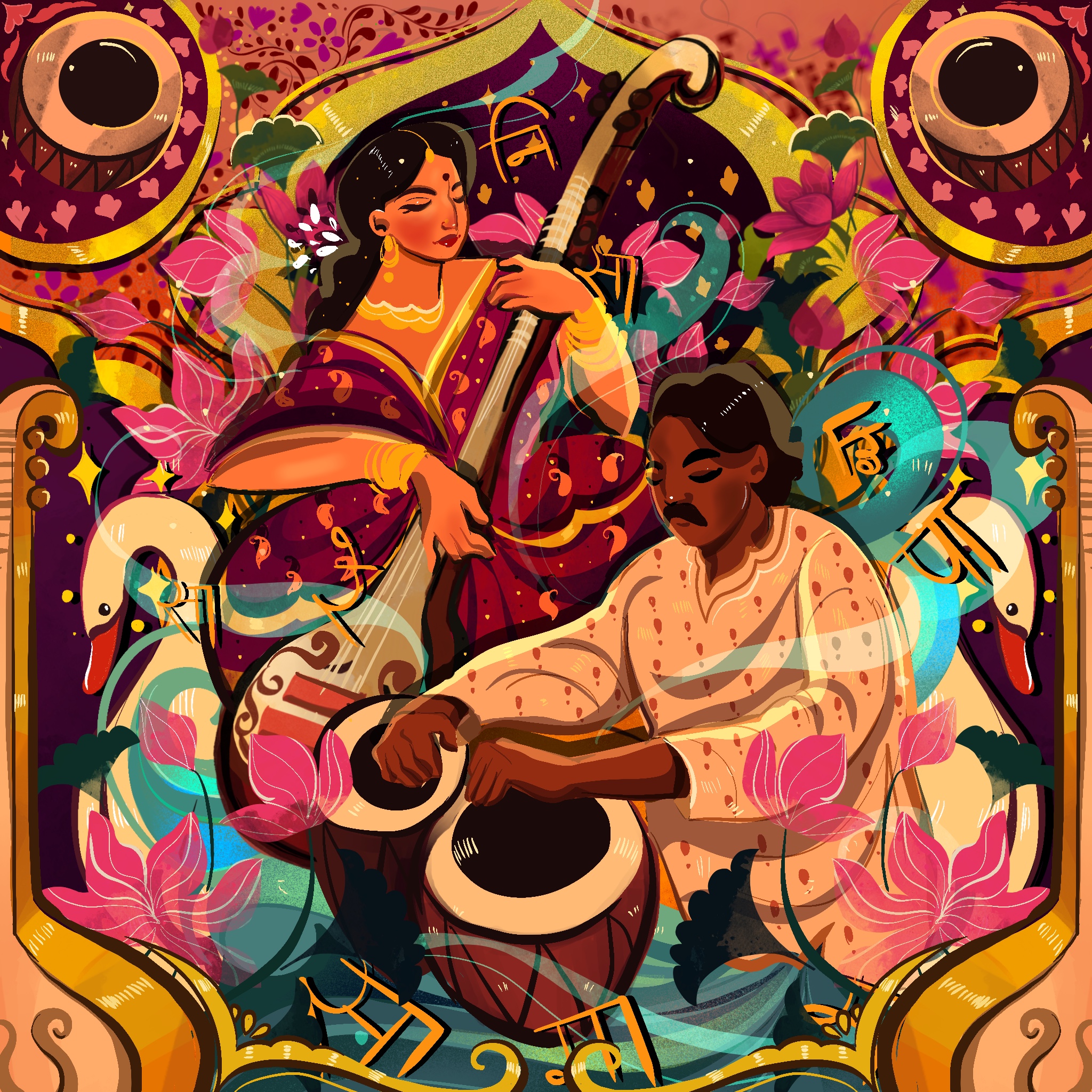
The Rich Heritage of Indian Classical Music
Exploring the deep roots and evolution of Indian classical music traditions.
Indian classical music is one of the world’s oldest and most profound musical traditions, deeply rooted in spirituality, culture, and philosophy. With origins tracing back over 2,000 years to the Vedas—especially the Samaveda—this art form has evolved through centuries while preserving its core principles.
Origins and Development
The roots of the classical music of India are found in the Vedic literature of Hinduism and the ancient Natyashastra, the classic Sanskrit text on performing arts by Bharata Muni. The 13th century Sanskrit text Sangeeta-Ratnakara of Sarangadeva is regarded as the definitive text by both the Hindustani music and the Carnatic music traditions.
Major Traditions
Indian classical music is broadly divided into two main systems:
Hindustani Classical Music (North India): Influenced by Persian and Mughal cultures, it emphasizes improvisation and expressive exploration. Popular forms include Dhrupad, Khayal, Thumri, and Tappa.
Carnatic Classical Music (South India): More structured and composition-focused, it highlights devotional themes and complex rhythmic patterns. Key forms include Kritis, Varnams, and Tillanas.
Indian classical music has two foundational elements.
Raga :
A raga is a central concept of Indian music, predominant in its expression. According to Walter Kaufmann, though a remarkable and prominent feature of Indian music, a definition of raga cannot be offered in one or two sentences. A raga has a given set of notes, on a scale, ordered in melodies with musical motifs. The Indian tradition suggests a certain sequencing of how the musician moves from note to note for each raga, in order for the performance to create a rasa (mood, atmosphere, essence, inner feeling) that is unique to each raga. A raga can be written on a scale. Theoretically, thousands of raga are possible given 5 or more notes, but in practical use, the classical Indian tradition has refined and typically relies on several hundred. For most artists, their basic perfected repertoire has some forty to fifty ragas. Raga in Indian classical music is intimately related to tala or guidance about "division of time", with each unit called a matra (beat, and duration between beats).
A raga is not a tune, because the same raga can yield a very large number of tunes. A raga is not a scale, because many ragas can be based on the same scale.
Tala:
The tala forms the metrical structure that repeats, in a cyclical harmony, from the start to end of any particular song or dance segment, making it conceptually analogous to meters in Western music. However, talas have certain qualitative features that classical European musical meters do not. For example, some talas are much longer than any classical Western meter, such as a framework based on 29 beats whose cycle takes about 45 seconds to complete when performed. Another sophistication in talas is the lack of "strong, weak" beat composition typical of the traditional European meter. In classical Indian traditions, the tala is not restricted to permutations of strong and weak beats, but its flexibility permits the accent of a beat to be decided by the shape of musical phrase.
The most widely used tala in the South Indian system is adi tala. In the North Indian system, the most common tala is teental. In the two major systems of classical Indian music, the first count of any tala is called sam.
Instruments and Vocal Traditions
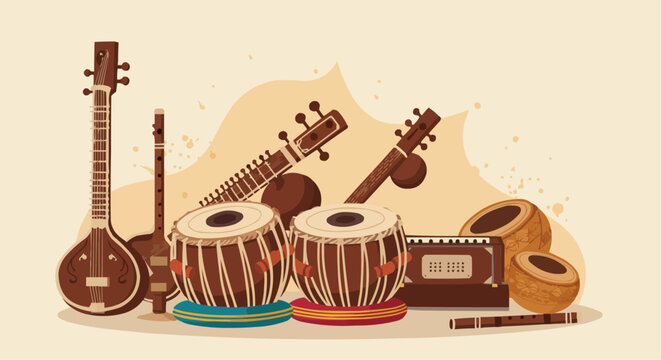
Indian classical music features a rich array of instruments:
String: Sitar, Veena, Sarod, Tanpura, Santoor, Sarangi, Violin
Percussion: Tabla, Mridangam, Pakhawaj, Ghatam, Kanjira
Wind: Bansuri, Shehnai, Nadaswaram
Key Instruments: Harmonium
Vocal music holds a central place, with styles passed down through the Guru–Shishya Parampara (teacher–disciple tradition).
Note system:
Indian classical music is both elaborate and expressive. Like Western classical music, it divides the octave into 12 semitones of which the 7 basic notes are, in ascending tonal order, Sa Re Ga Ma Pa Dha Ni for Hindustani music and Sa Ri Ga Ma Pa Dha Ni for Carnatic music, similar to Western music's Do Re Mi Fa So La Ti. However, Indian music uses just-intonation tuning, unlike some modern Western classical music, which uses the equal-temperament tuning system. Also, unlike modern Western classical music, Indian classical music places great emphasis on improvisation.
The underlying scale may have four, five, six or seven tones, called swaras (sometimes spelled as svaras). The swara concept is found in the ancient Natya Shastra in Chapter 28. It calls the unit of tonal measurement or audible unit as Śhruti, with verse 28.21 introducing the musical scale as follows,
तत्र स्वराः –
षड्जश्च ऋषभश्चैव गान्धारो मध्यमस्तथा ।
पञ्चमो धैवतश्चैव सप्तमोऽथ निषादवान् ॥ २१॥
— Natya Shastr
a, 28.21
Organization
Sangeet Natak Akademi, is an Indian national-level academy for performance arts. It awards the Sangeet Natak Akademi Award, the highest Indian recognition given to people in the field of performance arts.
SPIC MACAY, established in 1977, has more than 500 chapters in India and abroad. It claims to hold around 5000 events every year related to Indian classical music and dance. Organizations like Prayag Sangeet Samiti, among others, award certification and courses in Indian classical music.
Akhil Bharatiya Gandharva Mahavidyalaya Mandal (अखिल भारतीय गान्धर्व महाविद्यालय मंडल) is an institution for the promotion and propagation of Indian classical music and dance.
A Living Tradition
Today, Indian classical music continues to thrive globally, inspiring fusion genres while maintaining its authenticity. Festivals, concerts, and digital platforms have helped carry this timeless heritage to new generations.
Cultural and Spiritual Significance
Beyond performance, Indian classical music is a meditative practice. It seeks harmony between the performer, listener, and the universe—making it both an art and a spiritual journey.
In essence, Indian classical music is not just sound—it is history, devotion, emotion, and identity woven into melody and rhythm.
Tags
About Author User
Content writer and journalist